
How to Search Criminal Dockets
Start with the county's Case Information and Calendars page. It points to the Michigan Court Application Portal, known as MiCOURT. Van Buren County labels the 36th Circuit Court as C36. The 7th District Court goes by D07. Choose the court first. Adult criminal matters usually begin in district court, so D07 is the likelier place to find an arraignment, warrant, bond, or early-stage record. A felony that moves forward can pick up a later circuit record too.
A case number is your best tool. A name search works, but it proves nothing by itself. Before trusting a result, match the court, year, case type, participant role, and date. MiCOURT itself warns that public results are informational. They may leave out older or restricted material. When you need a document, a certified copy, or a missing entry explained, call the record-holding court. Don't treat the search result as the whole file.
- Open the county case-information page and choose C36 or D07.
- Enter the case number exactly as printed, or begin with a participant’s last name.
- Use the court, year, and case-type details to narrow similar-name results.
- Open the matching record and read the register of actions in date order.
- Call or visit the responsible clerk for a fuller public file or a copy.
Van Buren Criminal Court Routes
Jurisdiction explains why one event lands in a different court record from another. Where does a case start? Adult misdemeanors, arraignments, bail, warrants, and felony preliminary examinations belong to the 7th District Court of Michigan. Felony trials, sentencing, and serious misdemeanors fall to the 36th Circuit Court of Michigan, Van Buren County. A bind-over moves a felony from the district preliminary stage up to circuit court. That word describes movement, not an outcome.
The county’s 7th District Court page explains the district court’s role directly. Its Paw Paw and South Haven locations share the D07 MiCOURT route. Circuit runs on C36. Run both searches when a record hints at a felony transfer or the court field is unclear.
Court changes can also spawn a second case number. Give the clerk the court identifier along with the year and type code when asking for help. That detail helps. Staff can then tell a district preliminary record apart from a circuit case with a similar caption.
The 36th Circuit Court’s official county page shows the general-jurisdiction court. It takes qualifying felony cases after district proceedings.
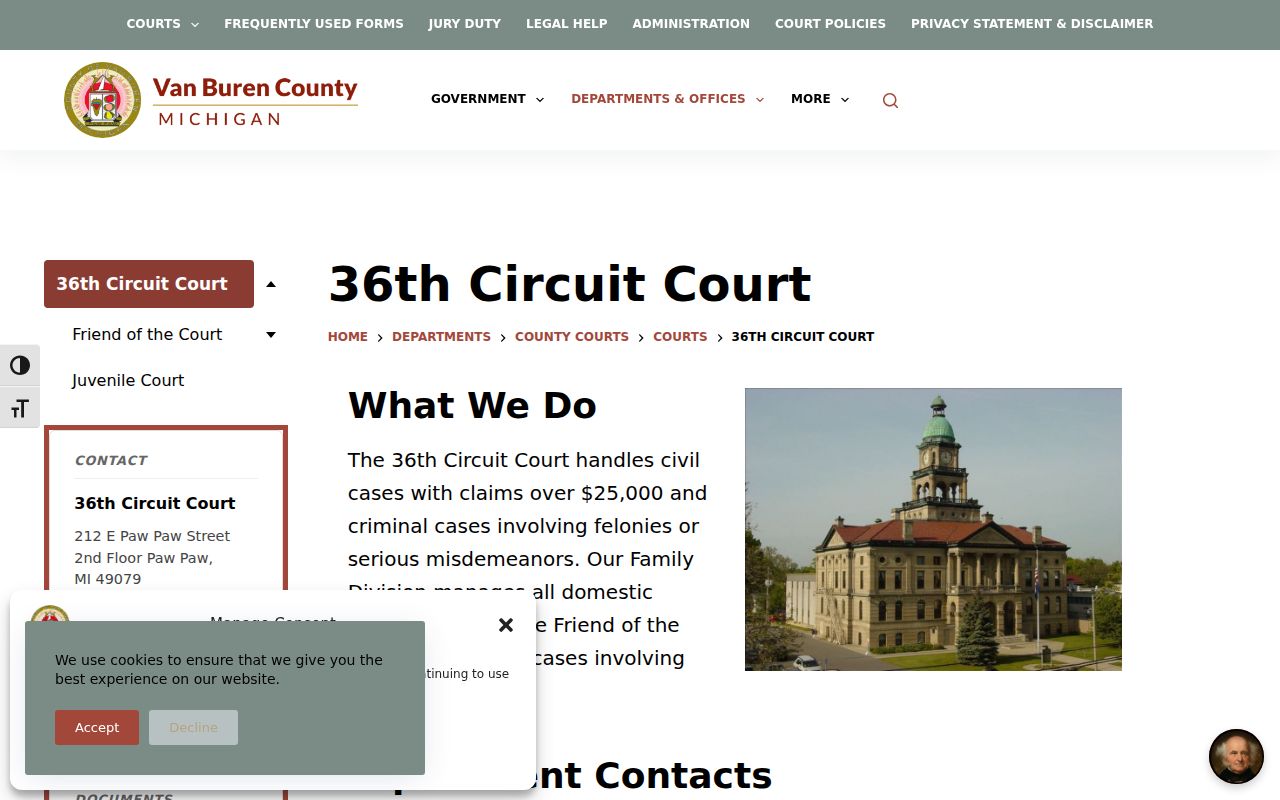
The route matters for a simple reason. The public register of actions follows whichever court holds the case at each stage.
What a Criminal Docket Shows
The clerk maintains a Michigan register of actions. It works as a case chronology. In a Van Buren criminal record, entries can include the case number, charge description, warrant or complaint date, arraignment, bond, hearing settings, motions, plea, trial, sentence, financial assessments, probation reviews, dismissal, and closure. What appears depends on the court and its public-access settings. Remember the distinction that runs through it all. A charge is an allegation. A plea, verdict, judgment, or sentence is a later event with different legal meaning.
| Case number | A local identifier that commonly combines a year, number, and type code, such as 2026-123456-FH. |
|---|---|
| Charge and statute | The alleged offense and cited law or ordinance. It is not a finding by itself. |
| Setting | An arraignment, preliminary examination, motion, trial, sentencing, review, or other scheduled event. |
| Register entry | A dated action in the case history. Its date can differ from a filing, hearing, signing, or service date. |
| Disposition | A closure or outcome event, such as dismissal, plea, verdict, transfer, or sentence. |
MiCOURT documentation lists optional fields too. Public results may show participants, charges, prosecutor, judge, next hearing, petitions, and balance information. Not every field appears for every case. When the precise record matters, verify the entry with the clerk.
Van Buren Charge and Disposition Entries
Some docket words invite overreading. “Charge filed” only means an accusation has entered the court record. “Arraignment” marks the stage where charges and rights are addressed. A next date gets set. The “preliminary examination” is the district court’s probable-cause step in a felony case. It can be waived, adjourned, or resolved another way. “Bind-over” signals movement toward circuit court. Not one of those labels, standing alone, is a final adjudication.
- FH
- Noncapital felony circuit criminal case code in the statewide SCAO table.
- FY
- Felony district-court criminal case code while the matter is in its district phase.
- SM
- Statute misdemeanor district criminal case code.
- ROA
- Register of actions, the chronological case history maintained under MCR 8.119.
Read the whole sequence instead of one label. MiCOURT also warns that an attempted felony may show as FELONY with a separate attempt, conspiracy, or solicitation marker. Trust the docket and the cited statute over a shorthand search label.
Stages on a Criminal Docket
A Van Buren County criminal case typically opens with a complaint, warrant, or filing in the 7th District Court. From there the district docket may show arraignment, bond, a preliminary-examination or probable-cause setting, and then a waiver, dismissal, or bind-over. If a felony moves to the 36th Circuit Court, the circuit record takes over with later motions, plea negotiations, trial activity, sentencing, and probation reviews.
Docket flow: Filing › Arraignment › Pretrial › Plea or Trial › Disposition › Sentencing
A hearing date on the docket is not proof it happened. Look for an adjournment, a later order, or a completed-event entry before relying on any date. And if the record shows a transfer, search again in the receiving court rather than treating the first court’s history as the whole file.
Van Buren Specialty Criminal Dockets
Van Buren County ties several specialty programs to its trial courts. These include Mental Health Court, Drug Treatment Court, Sobriety Court, Swift & Sure intensive supervision, and others. None of these is a new level of court. A docket entry naming one of the programs can point to treatment, supervision, recovery work, family goals, or public-safety planning. It shows only that. The entry does not establish eligibility, completion, a conviction, or any particular disposition.
The county's Specialty Courts page names each program and gives its local contact channel. What it shares publicly can run thinner than the ordinary court docket, so ask first. Check with the program or the court. Ask whether participant-level information is available. Don't assume a public case search will show it.
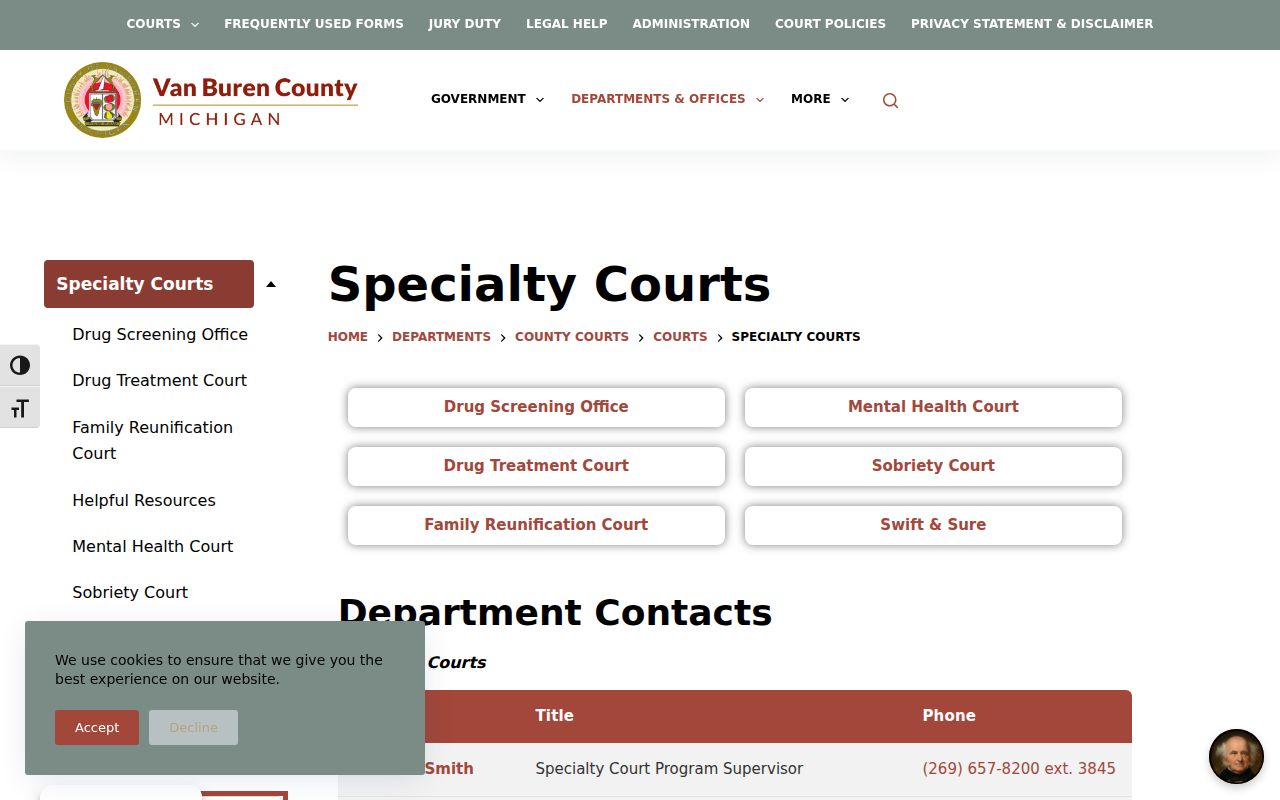
The program listing is useful context. Still, the register of actions and the responsible court remain the records that verify a docket entry.
Which Court Holds Criminal Dockets
For adult criminal matters in Van Buren County, the 7th District Court is the main entry point. It sits in Paw Paw and in South Haven. Both locations route public case searches through D07. The 36th Circuit Court handles qualifying felonies and uses C36. County pages put early felony proceedings in district court. Felony trials and sentencing happen in circuit court.
Juvenile files go through Juvenile Court instead. They are not ordinary adult district or circuit criminal files. Suzie Roehm serves as County Clerk. She is also Clerk of the Circuit Court. That does not make her office the keeper of every district, probate, or juvenile record. Send each request to the court that owns the file.
The county links the D07 MiCOURT route as a starting point for district criminal information.
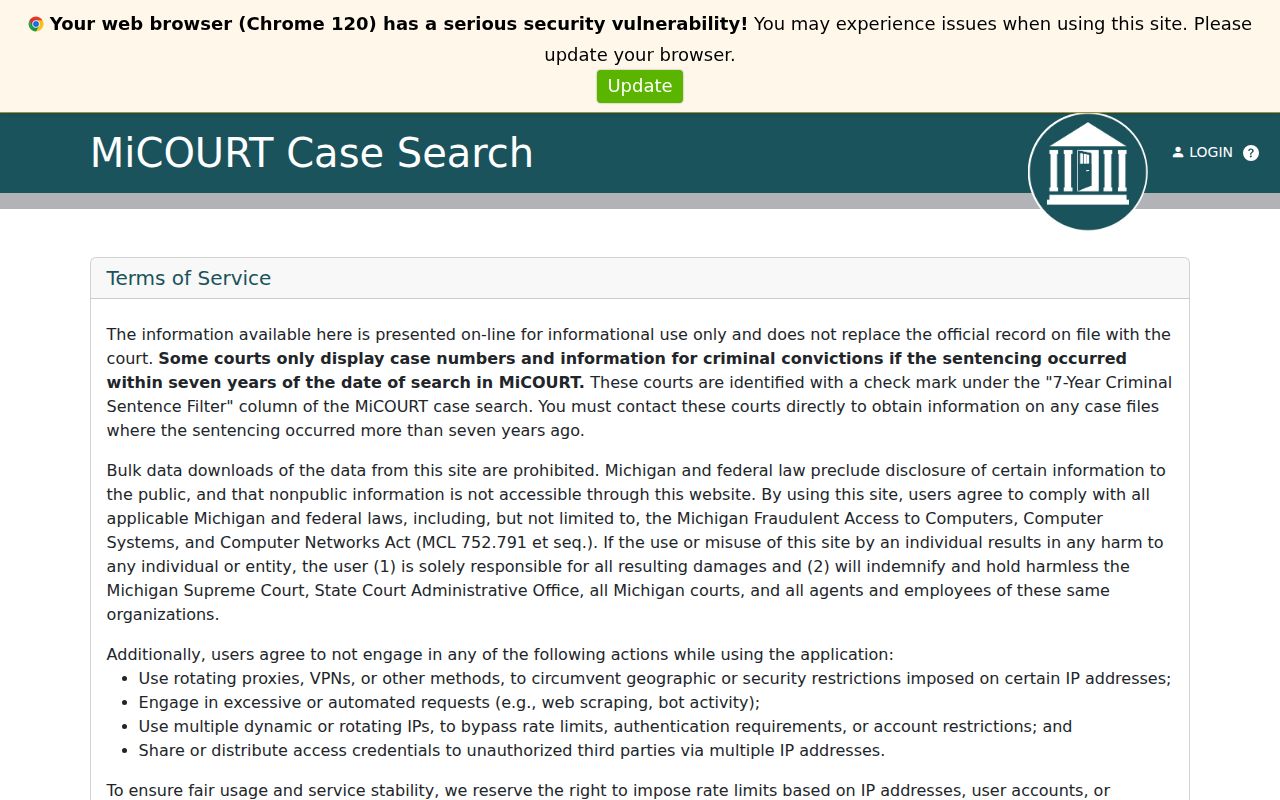
Pick the right court first. Then compare the case number and register entries, especially once a felony has moved past the preliminary stage.
Van Buren Criminal Filing Context
Big caseloads explain why a court and case number beat a broad name search. The Michigan judiciary's 2023 report for the 36th Circuit Court recorded 696 criminal filings. The grand total was 1,932 filings. The detailed table counted 663 new criminal noncapital-felony filings. Those are workload numbers. They say nothing about individual outcomes or a count of convictions.
The county prosecutor's 2026 year-end report measures other things: warrant-review requests and authorized misdemeanors. Do not mix those office figures with court-filing totals. For one case, the court's register of actions governs.
Public Access and Sealed Criminal Dockets
MCR 8.119 governs trial-court records. It names the register of actions and generally permits inspection and copying. Access can be restricted by statute, court rule, or court order. MiCOURT is a public index. It is not a full mirror of every file. Older or restricted material can be suppressed there, and court staff can explain how to inspect a public record or order a copy.
Public-access note. A blank search result does not prove that a criminal matter never existed, was dismissed, or was sealed. Juvenile records are not open to the general public under MCL 712A.28, and other records can be limited by statute, rule, redaction, protective order, or a sealing order.
Michigan FOIA is not the usual way to get a court file. Case records answer to MCR 8.119 and the court's own access rules. So the responsible court is where you ask. That means the counter, a phone call, or a mailed request for a case record. Save the county FOIA process for county administrative records instead.
If you already have a case number in hand, the county's Van Buren case search is a practical next step. It pulls up the docket entry you need.
The official 7th District Court page posts the court's procedures, contacts, and current information. It comes straight from the county.
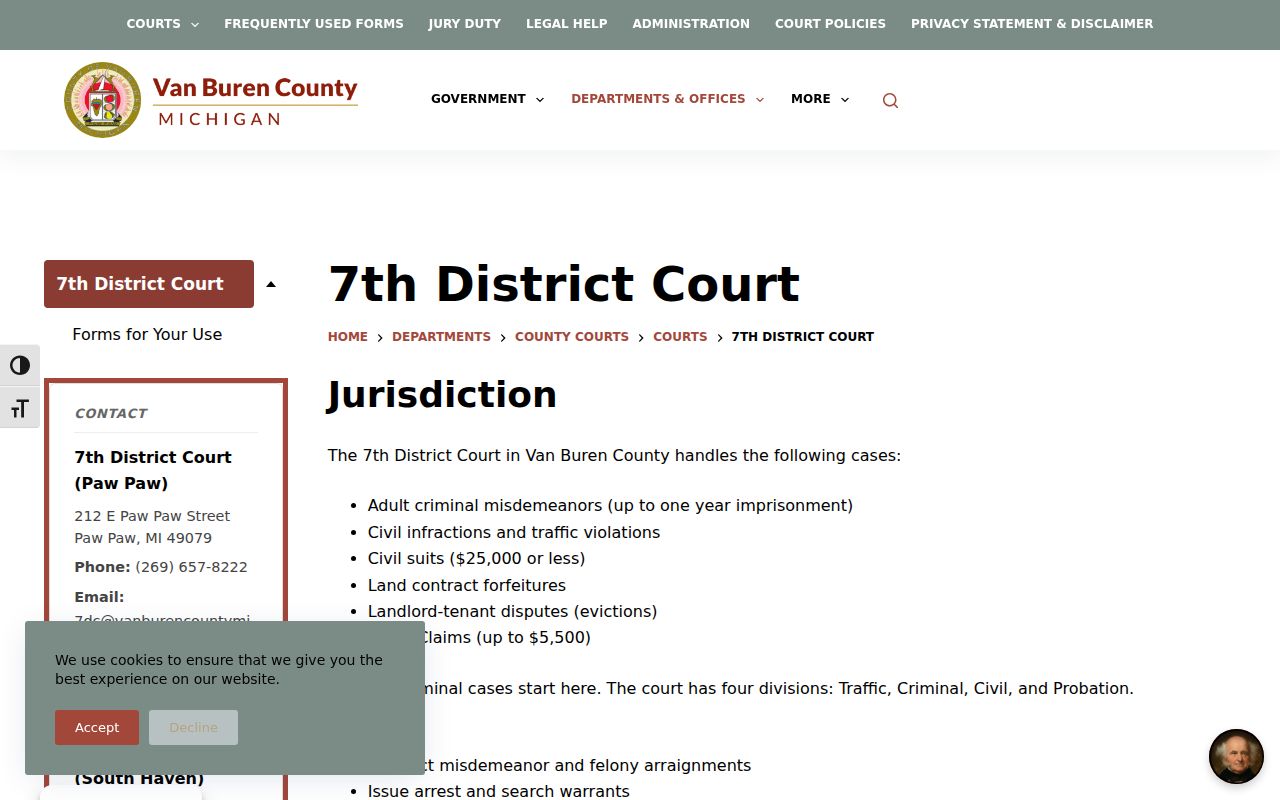
A public file may sit beyond the online register. To get it, confirm the court, case number, requested document, and copy type with the clerk who keeps the record.
Van Buren Juvenile Access Limits
Public criminal searching has hard limits in Van Buren County. MiCOURT's public-display notice excludes or suppresses certain categories. Juvenile and child-protective proceedings are among them. Mental-illness matters, adoption, name changes, personal-protection-order matters, and wills are held back too. A missing result is therefore a portal limitation. It is not a conclusion about the person or the case.
Redaction and sealing differ. Redaction strips protected details from an otherwise public document. Sealing closes access under legal authority or a court order. Someone with a legitimate reason to seek a restricted record should ask the responsible court. The court can explain its request process and the law or order that applies. The docket alone proves nothing the public record does not.